Ahmedabad to Jaipur by Road – Route, Distance, Highway Stops and Complete Travel Guide 2026
Aug 04 2026
Most people who do the Ahmedabad to Jaipur drive for the first time are surprised by how good it actually is.
They expect a long, flat, monotonous highway slog. What they get instead is a journey that changes character every hundred kilometres. The flat agricultural plains around Mehsana give way to the scrubby semi-arid landscape approaching the Rajasthan border. The landscape opens up dramatically after Palanpur. The Aravalli foothills appear and disappear on the horizon. And then Rajasthan begins doing what Rajasthan does, ochre soil, roadside temples, camel carts still occasionally appearing on service roads, and the particular quality of light that makes the state so visually distinctive.
The distance is real. At around 650 to 670 km, this is not a casual day trip. It is a proper road journey that deserves proper planning. Done right, it is one of the more satisfying drives you can make from Ahmedabad, connecting two historically rich cities across a stretch of landscape that earns its place in the journey.
This guide covers everything you need to plan the route, where to stop, what to watch for on the road, and how to make the journey work rather than just endure it.
Distance and Route from Ahmedabad to Jaipur
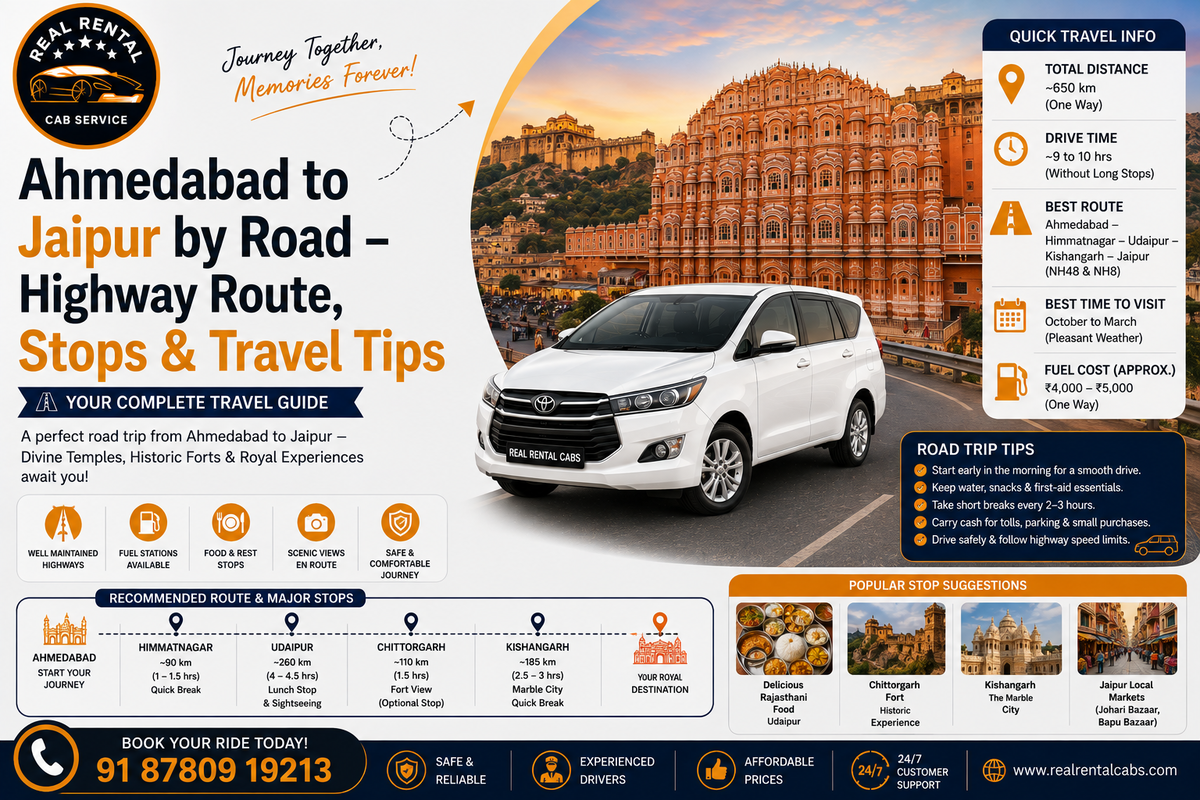
The main route between Ahmedabad and Jaipur runs via NH48 north from Ahmedabad through Mehsana and Palanpur, crossing into Rajasthan near Abu Road and continuing through Pali and Ajmer before reaching Jaipur.
An alternative route goes via Udaipur, which adds significant distance but passes through considerably more interesting terrain and allows combining Udaipur as a stop.
| Route | Total Distance | Approx Drive Time | Character |
|---|---|---|---|
| Via NH48 through Pali and Ajmer | 650 km | 9.5 to 11 hours | Fastest, mostly highway |
| Via Udaipur and Chittorgarh | 780 km | 11 to 13 hours | Longer but more scenic |
How far is Jaipur from Ahmedabad by road? Jaipur is approximately 650 to 670 km from Ahmedabad via the NH48 route through Palanpur, Abu Road, Pali, and Ajmer, taking around 9.5 to 11 hours of driving under normal traffic conditions. The alternative route via Udaipur adds approximately 130 km but passes through more historically interesting terrain.
The NH48 direct route is the choice for most people driving for business or with limited time. The Udaipur route is the choice for families doing a larger Rajasthan road trip where the journey is part of the experience rather than just the means of getting there.
This guide covers the direct NH48 route in detail because that is what most Ahmedabad to Jaipur travellers use. The Udaipur alternative is mentioned at the end for those planning a longer circuit.
The NH48 Route in Detail – Section by Section
Understanding the route in sections helps you plan stops, fuel, and timing properly rather than thinking of it as one undifferentiated 650 km stretch.
Ahmedabad to Mehsana – 75 km
The first section is the most familiar for Ahmedabad residents. NH48 heading north is well-maintained expressway standard for most of this stretch. Mehsana is the first significant town and a natural first fuel and breakfast stop if you leave Ahmedabad early.
The Ahmedabad to Mehsana section takes approximately 60 to 75 minutes in normal traffic. Leaving Ahmedabad before 6 AM gets you through the city outskirts before traffic builds. Leaving after 8 AM means navigating the city exit during peak hour which can add 30 to 45 minutes on congested days.
Mehsana to Palanpur – 55 km
This section continues north on good state highway. The landscape becomes progressively more arid and open. Palanpur, the district headquarters of Banaskantha, is the last major Gujarat town before the Rajasthan border and another natural stop for fuel.
If you are combining the trip with an Ambaji visit, the turnoff toward Ambaji is between Mehsana and Palanpur, roughly at Thara. Most people doing Ahmedabad to Jaipur directly skip Ambaji but those doing a longer Rajasthan circuit sometimes build in an Ambaji stop here before continuing north.
Palanpur to Abu Road – 55 km
This section crosses into increasingly Rajasthani landscape as you approach the Aravalli foothills. Abu Road is the railhead town at the base of the Mount Abu ghat and a significant railway junction for trains between Gujarat and Rajasthan.
If you are visiting Mount Abu, the ghat road turnoff is at Abu Road town. For those going directly to Jaipur, you pass through Abu Road and continue north on NH27 without turning off.
Abu Road to Pali – 130 km
This is the longest section between stops and passes through the western Rajasthan landscape that most people associate with the state when they imagine it. The road quality on NH27 between Abu Road and Pali is generally good with a four-lane divided highway for significant stretches.
The landscape here is semi-arid with the characteristic low scrub vegetation, rocky outcrops, and small villages built in traditional Rajasthani style that look very different from Gujarat village architecture. This is the section where the journey feels most distinctly like Rajasthan.
Pali is a significant textile town in Rajasthan and a useful midpoint stop for fuel and lunch. Several decent highway restaurants operate near the main bypass.
Pali to Ajmer – 130 km
Continuing northeast from Pali toward Ajmer, the landscape becomes slightly more populated and agricultural as you approach the more central Rajasthan districts. The road quality remains good throughout this section.
Ajmer is a significant city historically, best known for the Dargah Sharif of Khwaja Moinuddin Chishti, one of the most important Sufi shrines in India. If you have time and interest, Ajmer warrants a stop of at least two hours. The city is 11 km off the main highway but well signposted.
Pushkar, the famous pilgrimage town with its sacred lake and Brahma temple, is 14 km from Ajmer and worth a stop if your timing allows. Pushkar is one of those places that makes you wish you had planned to stay longer.
Ajmer to Jaipur – 130 km
The final section from Ajmer to Jaipur on NH48 is among the best road in the entire journey. Four-lane divided highway, good surface quality, and relatively light traffic compared to the Gujarat stretches. This section moves faster than you expect after the Rajasthan interior roads.
The outskirts of Jaipur begin around 20 km before the city centre. Traffic builds from here and the final approach into central Jaipur through the expanding city can take 30 to 45 minutes depending on time of arrival.
Where to Stop on the Ahmedabad to Jaipur Drive
Mehsana – km 75 – Fuel and Breakfast
Leave Ahmedabad early and stop at Mehsana for breakfast. The town has several decent highway restaurants and the familiar Gujarat snack options including poha, thepla, and jalebi that work well for a road trip breakfast. Fuel is readily available and prices are standard.
Palanpur – km 130 – Fuel and Stretch
A brief stop to fuel and stretch before the more arid Rajasthan section. Palanpur has basic facilities. Not a destination stop but a sensible logistics pause.
Pali – km 390 – Lunch
Pali marks roughly the halfway point of the journey and is the best lunch stop on the direct route. Highway restaurants near the Pali bypass serve standard North Indian and Rajasthani thali. The Rajasthani dal baati churma appears on menus here for the first time on the journey northward, and trying it at this point makes geographical sense.
Ajmer or Pushkar – km 520 – Optional Extended Stop
If you departed Ahmedabad by 5 AM you should reach the Ajmer area by 2 to 3 PM, leaving reasonable time for a visit. Ajmer Dargah takes 90 minutes minimum. Pushkar with the lake, ghats, and Brahma temple takes 2 to 3 hours. Combining both is possible but makes the Jaipur arrival late evening.
For travellers doing a longer Rajasthan trip and staying overnight at various points, Ajmer or Pushkar as an overnight stop before Jaipur the following morning is the most unhurried approach to the journey.
Jaipur outskirts – km 650 – Final fuel
Fill up fuel before entering central Jaipur as city petrol stations are often more congested and the prices in some tourist-facing areas can be slightly higher than highway rates.
Timing Your Departure – When to Leave Ahmedabad
The departure time from Ahmedabad is the single most important planning decision for this journey. Get it right and the drive is manageable and even enjoyable. Get it wrong and you arrive at Jaipur exhausted and later than planned.
5 AM to 6 AM departure: The ideal window. You clear Ahmedabad before the city traffic starts, hit Mehsana well before 8 AM for a quick breakfast, and reach Pali before the afternoon heat peaks. Arrival in Jaipur is between 5 PM and 7 PM depending on stop duration, giving you a full evening in the city.
7 AM to 8 AM departure: Acceptable. Ahmedabad exit traffic adds time but is manageable. Lunch at Pali is on schedule. Jaipur arrival pushes to 7 PM to 9 PM. Still workable for a first night and a full day the next day.
After 9 AM departure: Challenging. You hit Ahmedabad city traffic during exit, reach Pali in the heat of the afternoon, and arrive in Jaipur after 9 PM or later. This is manageable if you are used to late drives but uncomfortable for families with children or elderly members.
Night driving departure (10 PM to 12 AM): Some experienced travellers prefer leaving late at night to cover the long flat sections between Palanpur and Pali in darkness when traffic is minimal and arrive in Jaipur in the early morning. The Rajasthan highway sections are safe and well lit in many stretches but the risk profile of night driving on state highways beyond Abu Road is higher than daytime. Not recommended for first-time route drivers or families.
The Scenic Alternative – Via Udaipur and Chittorgarh
If you have three or more days for this journey rather than a single long driving day, the Udaipur route is worth serious consideration.
The Udaipur alternative adds approximately 130 km to the total distance but passes through Udaipur, one of the most beautiful cities in India, and Chittorgarh, with its extraordinary hilltop fort complex that is arguably the most historically significant fort in Rajasthan.
A comfortable version of this route:
Day one: Ahmedabad to Udaipur via Nathdwara (300 km). Stop at Nathdwara for a jhanki darshan, continue to Udaipur. Arrive early evening.
Day two: Full day in Udaipur covering City Palace, Pichola Lake, and old city lanes. Stay in Udaipur.
Day three: Udaipur to Chittorgarh (115 km). Half day at Chittorgarh Fort. Continue to Ajmer or Pushkar (140 km). Stay overnight.
Day four: Morning at Pushkar, afternoon drive to Jaipur (135 km). Arrive early afternoon.
This four-day route is one of the finest road journeys in western India. Combining Nathdwara, Udaipur, Chittorgarh, and Pushkar before arriving at Jaipur gives you a genuinely comprehensive experience of Rajasthan's most significant sites without any single day feeling rushed.
For families doing this extended circuit, our Ahmedabad to Jaipur cab service covers multi-day bookings across this entire route with consistent driver and vehicle throughout.
What to Do in Jaipur Once You Arrive
Jaipur deserves at least two full days of exploration after the journey from Ahmedabad. The city is larger and more complex than most first-time visitors expect.
Amber Fort: 11 km from the city centre, the Amber Fort complex is the most important historical site in the Jaipur area. The fort was the seat of the Kachwaha Rajput rulers before Jaipur was established and the palace interiors including Sheesh Mahal, the mirror palace, and the Diwan-i-Khas are of exceptional quality. Allow three hours minimum.
City Palace: The royal palace at the centre of the old city remains a residence of the Jaipur royal family. The museum sections open to the public contain extraordinary textile and weapons collections. The Chandra Mahal complex is visible from the public areas even if full access requires separate ticketing.
Hawa Mahal: The five-storey pink sandstone facade overlooking the main bazaar is the most iconic image of Jaipur. The interior is more complex than the exterior suggests, with 953 small windows designed to allow royal ladies to observe street life without being observed.
Jantar Mantar: The 18th-century astronomical observatory built by Maharaja Jai Singh is a UNESCO World Heritage Site. The instruments are not decorative. They were functional scientific tools and the largest one, the Samrat Yantra sundial, was accurate to two seconds in 1734 and remains usable today.
Old City Bazaars: The lanes of the old walled city contain some of the best traditional markets in India. Johari Bazaar for jewellery, Bapu Bazaar for textiles, and the lanes around the City Palace entrance for handicrafts reward unhurried exploration more than any single monument.
Nahargarh Fort: On the ridge above the city, Nahargarh gives panoramic views over Jaipur. Best visited at sunset when the city below turns golden and the lights begin appearing across the pink city rooftops.
Fuel and Road Facilities on This Route
The Ahmedabad to Jaipur route has adequate fuel infrastructure throughout with no genuinely remote sections between fuel stops.
Fuel stations are regular on NH48 in Gujarat. After the Rajasthan border, NH27 toward Pali has fuel at intervals but gaps between stations can reach 40 to 50 km in some sections. Keeping your tank above half when leaving Palanpur is a sensible habit.
Between Pali and Ajmer on NH48, fuel availability improves significantly as you move into more densely populated central Rajasthan.
ATMs are available in every town of significance along the route. Carry some cash for smaller dhabas and highway services that may not accept cards reliably.
Mobile network is good on NH48 in Gujarat throughout. After the Rajasthan border, Airtel and Jio have reasonable coverage but there are dead zones in sections between Abu Road and Pali. Download offline maps covering the full route before departing.
Practical Tips for the Ahmedabad to Jaipur Drive
Carry two spare tyres for long highway drives in India if possible, or at least confirm your existing spare is in good condition. The distance makes a tyre issue more consequential than on shorter trips.
The Rajasthan border checkpoint between Palanpur and Abu Road typically requires a brief stop for commercial vehicles and sometimes for tourist cabs. Carry all vehicle and passenger documents in an accessible location rather than buried in luggage.
Rajasthan state has different toll booth systems and some stretches between Abu Road and Pali use older manual toll collection that can be slower than the FASTag lanes you are accustomed to in Gujarat. Budget extra time at toll booths on this section.
Avoid driving the Pali to Ajmer section during high-traffic festival periods, particularly around Pushkar Mela in October or November when traffic volumes near Pushkar and Ajmer increase dramatically and detours through small roads become necessary.
The final approach into Jaipur from the Ajmer highway side passes through several developing suburban areas with significant construction activity. Follow GPS guidance carefully as road configurations in the Jaipur outskirts change frequently with ongoing development.
For families using our outstation cab from Ahmedabad for this journey, drivers familiar with the route handle the logistics of the border crossing, toll booths, and Jaipur city entry more smoothly than first-time route drivers managing navigation and driving simultaneously.
Frequently Asked Questions
Is it safe to drive from Ahmedabad to Jaipur by road?
Yes. The NH48 and NH27 route between Ahmedabad and Jaipur is a well-travelled national highway corridor in good condition throughout. Daytime driving is straightforward. Standard road safety precautions apply and night driving on the Rajasthan state highway sections beyond Abu Road is manageable but carries higher risk than daytime travel on the same roads.
What is the best vehicle for the Ahmedabad to Jaipur road trip?
Any comfortable car handles this route well as the roads are good throughout. For families of five or more, an Innova Crysta or Ertiga is strongly recommended for the combination of space and highway comfort over a 650 km journey. The extra space over ten to eleven hours of driving makes a significant difference to passenger comfort.
Are there good places to eat on the Ahmedabad to Jaipur highway?
Yes. Mehsana near Ahmedabad has good Gujarati breakfast options. Pali is the best lunch stop with Rajasthani thali available. The Ajmer and Pushkar area has both Rajasthani food and broader options. Highway dhabas between Palanpur and Pali are basic but functional.
How many days should I plan for an Ahmedabad to Jaipur road trip?
For a direct drive with one day in transit and two to three days in Jaipur, four to five days total is comfortable. For the extended scenic route via Udaipur, Chittorgarh, and Pushkar, six to seven days allows all destinations to be explored without rushing and is one of the finest road trip formats available from Ahmedabad.